
At midcentury, a mile-long tunnel under downtown moved people with a frequency most riders today would find hard to picture. At its peak, the Hollywood Subway carried 880 Pacific Electric Red Cars a day and roughly 20 million passengers a year. The front door to that underground world is still on the sidewalk: the old Subway Terminal Building at 417 S. Hill Street, today known as the Metro 417 apartments.
The line had a simple promise and a firm timeline. Opened in 1925, closed in 1955, it ran from that Hill Street terminal to Westlake and then fed outward to lines serving Hollywood, Glendale, Burbank, Santa Monica, and the San Fernando Valley. What we now describe as far-flung corners of Los Angeles were once one transfer away from a tunnel entrance busy enough to post those peak numbers. And by several accounts from local-history observers, much of the old infrastructure is still down there, out of sight but not fully gone.
This matters for a practical reason, not nostalgia. The surprise is not that Los Angeles once had trains. The surprise is the scale that ran beneath familiar blocks, and the way the bones of that system linger. A city that often tells itself it was built around the car built a mile of city under the city and ran it often enough to move those millions a year. Then it sealed the portals, renamed the building, and kept walking.
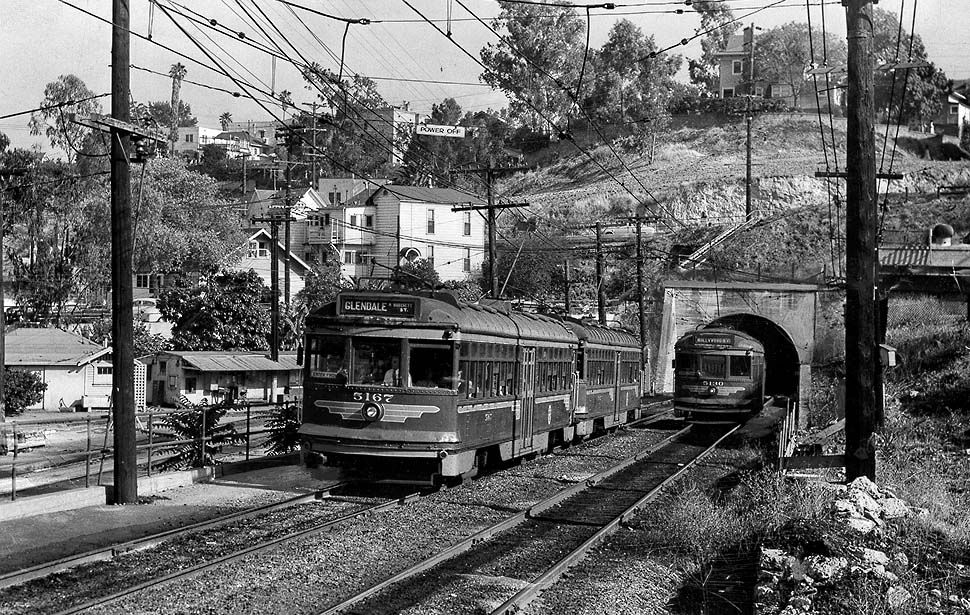
The route was tighter than its legend. About a mile from the terminal at 417 S. Hill Street to Westlake, then onward by connection, it was less a grand cavern and more a purposeful shortcut. It delivered riders to trains that served Hollywood, Glendale, Burbank, Santa Monica, and the San Fernando Valley. If you stand on Hill Street and look up at the facade that now says Metro 417, that is the place where the whole thing began each morning and ended each night.
The name that stuck is the Belmont Tunnel, a plain phrase that undersells the ambition behind it. The formal name that appears in the city's records is longer: the Belmont Tunnel / Toluca Substation and Yard. In 2005, the city gave that complex a formal historic designation as a Los Angeles Historic-Cultural Monument, listed as #790. The number matters less than the fact of its listing. It is a quiet acknowledgment that what sits under the newer paint is part of the civic story.
Nothing about the line's basic geometry is complicated. One portal downtown. A mile to Westlake. Connections spreading to those five destinations. The simplicity is part of the point. The tunnel was a hinge, not a network. It changed what was possible for riders who entered at Hill Street and expected to surface a short time later already aligned with a car to the Valley or the coast.
The numbers do the talking if you let them. 880 Red Cars a day is not an abstraction. That is an all-day cadence of arrivals and departures steady enough to be a soundtrack. 20 million passengers a year at its 1940s peak reads like a rounding error until you picture the people one by one, filing down and back up those stairs that are now another building's lobby.
Even if you do not remember riding it, you probably know someone who did, or know the blocks it connected. Hollywood. Glendale. Burbank. Santa Monica. The San Fernando Valley. Those names are on bus headsigns and traffic reports today. During the subway years, they were also the places stamped into a Red Car timetable that took a mile-long shortcut under downtown to keep the schedule honest.
The dates are specific enough to test your mental map of the city's past. The Hollywood Subway opened in 1925 and closed in 1955. It is an entire generation of commutes bounded by two years you can write on an index card. In between, those Pacific Electric Red Cars did the thing the numbers say they did, over and over, day after day. That is the part people skip past when they reduce the system to a postcard image. Trains are photographs. Schedules are facts.
The terminal's address helps ground the story. 417 S. Hill Street is not a memory exercise. It is a number on a building that now answers to a different name, Metro 417, where the front steps line up with a street that has cleared through-lines many times since the subway years. The plaque and the leasing office coexist, which is a very Los Angeles arrangement: history on a badge, future on the intercom.
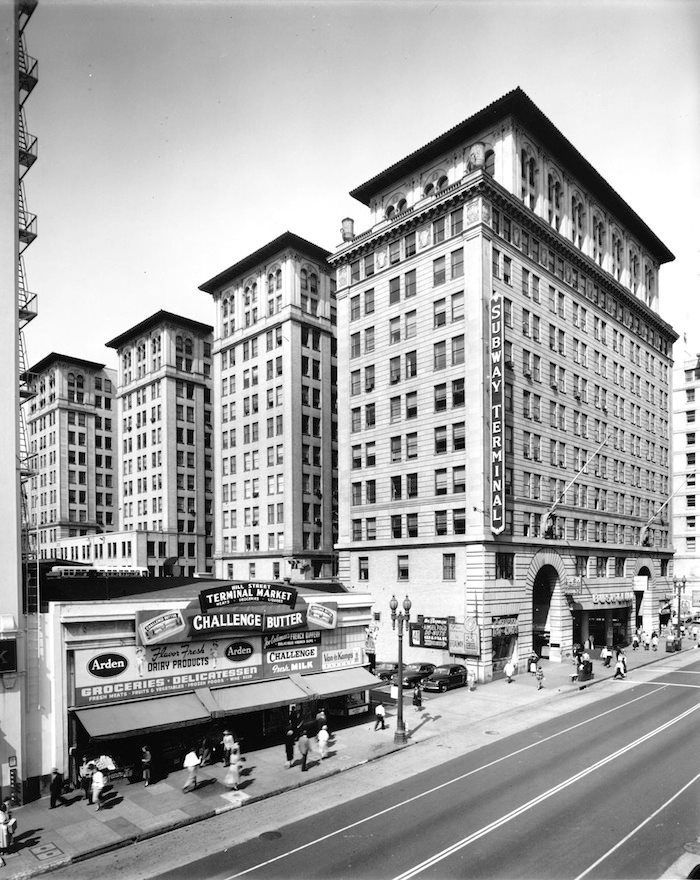
There is a line between what the city has stamped into its books and what enthusiasts say they have seen. On the official side, the Belmont Tunnel / Toluca Substation and Yard holds that 2005 historic designation as Los Angeles Historic-Cultural Monument #790. Beyond that, by several accounts from people who track the city's buried infrastructure, pieces of the old system remain in place. They talk about tracks. They mention platforms. They point to signage. None of that comes from a transit authority inventory or a museum exhibit list. It is the kind of knowledge that circulates among people who spend time with maps and closed doors.
You do not have to pick a side to feel the vertigo of it. Either the bones are as intact as those observers say, or they are intact enough to keep the story honest. In both cases, the mile is still a mile, the address is still the address, and the city's roll of historic places still includes a tunnel that once turned downtown into a hinge for the whole region.
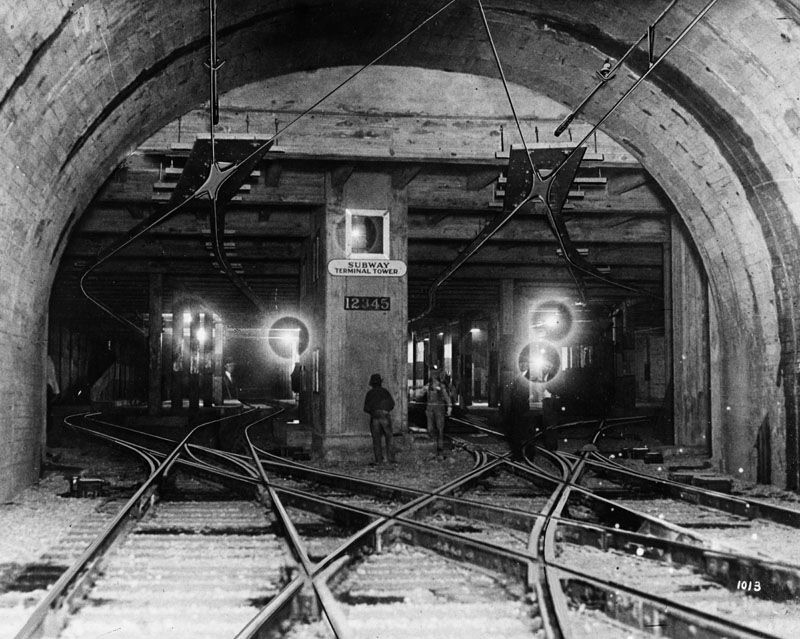
What is striking is how ordinary the surface looks. A building with a contemporary name. A lobby that serves residents instead of riders. An address that shows up in delivery apps. None of that cancels out the fact that this was once the busiest mouth of a short tunnel that fed outbound lines to Hollywood and beyond. The ease with which those two truths sit side by side is the point. You can live on top of a railroad and never know it, because this is a city that changes by overlay as much as by demolition.
The memory of a system can fade faster than the system's hardware. That is not sentimental. It is logistical. Concrete is patient. Signs are slower to rot than stories are to drift. The Los Angeles that closed the Hollywood Subway in 1955 is long gone, but the listing written into the city's own register in 2005 keeps the mile legible to anyone who wants to go looking. You do not need a tour. You just need to know the name and the address.
Walk past the entrance at 417 S. Hill Street and remind yourself that the tunnel behind that wall once sorted riders bound for Glendale, Burbank, Santa Monica, and the San Fernando Valley. If you tell the story straight, it does not need italics. A mile under downtown. 880 cars a day. 20 million riders a year at the peak. A formal listing that calls it by both names, Belmont Tunnel and Toluca Substation and Yard, and records it as #790. That is the checklist.
Every city has a few places where the floor gives way under your understanding and you realize there was more here than you saw. This is one of ours. The trains stopped in 1955. The building changed its sign. By several accounts, the hardware kept its shape. The numbers are still right there to be counted, whether you knew to look for them or not.